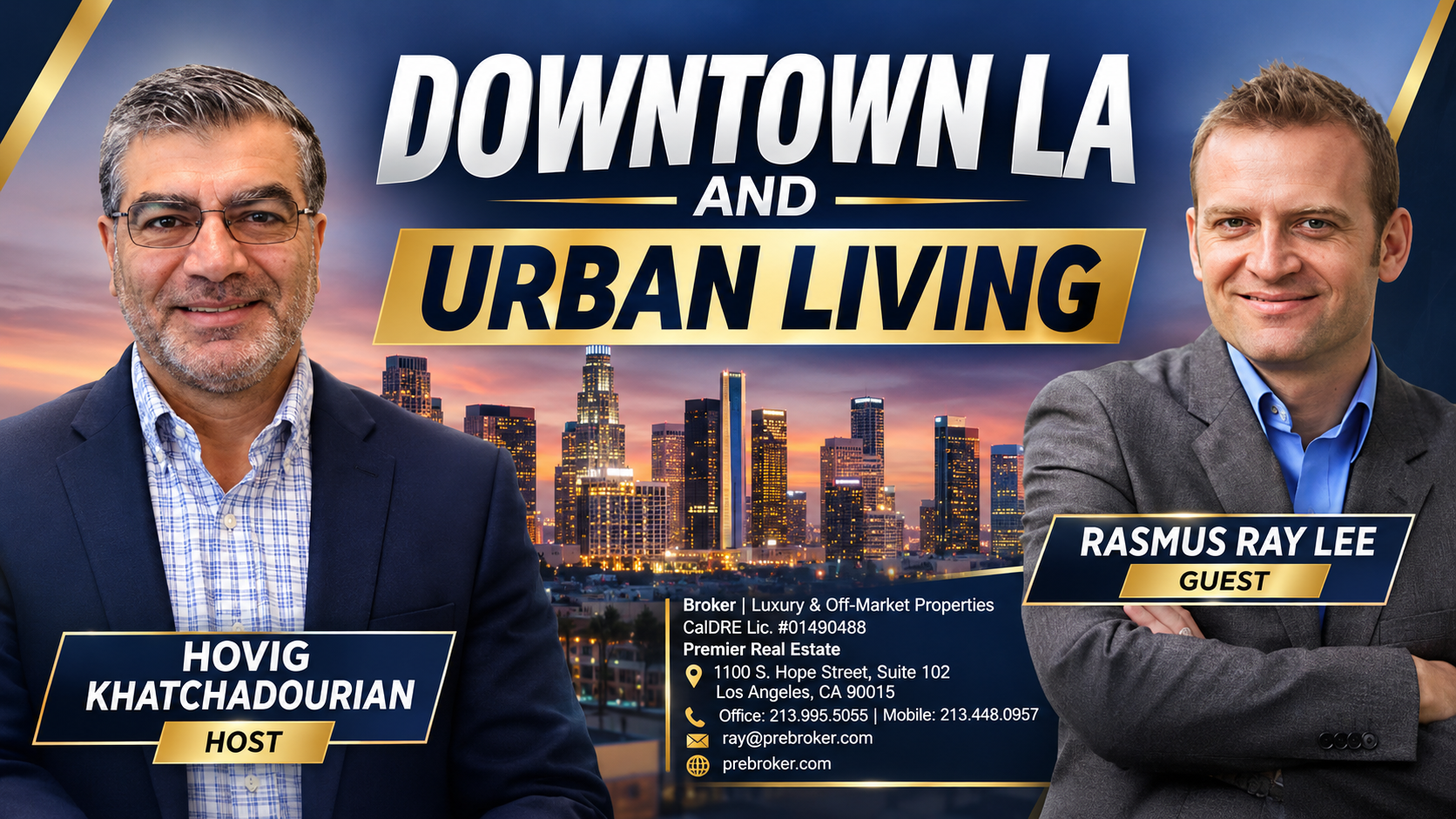
Downtown LA Realtor Ray Lee on Lofts, Urban Living, and Buying Now
Mortgage and Money With Hovig
On his show, Hovig Khatchadourian brings valuable conversations with local experts who understand the real estate markets they serve. This episode focused on downtown Los Angeles and urban living, with guest Rasmus Ray Lee of Premier Real Estate. Ray has been involved in downtown LA real estate for more than 20 years and specializes in the residential market, especially lofts and urban living. Hovig wanted to learn how the market has evolved and where it is headed.
From Jazz Saxophonist to Downtown Specialist
Ray is originally from Copenhagen, Denmark, and came to the United States in the early 1990s to play music. He spent about ten years in New York as a professional jazz saxophonist, touring, recording, and performing with his own trio at the Guggenheim Museum, before moving to Los Angeles in 1997. After some odd jobs, he entered real estate in 2004 as an assistant to his business partner, who was one of the first people to buy downtown as an investment, and the two started their company together. Ray earned his license in early 2005. He believed that if Los Angeles built high rises and revitalized a downtown that had been ignored for decades, it could become something like a small Manhattan, and the warm climate could only help. The company stayed busy through the credit crisis by handling short sales and foreclosures for both buyers and sellers.
How Downtown Has Changed
When Ray started, many developer contracts were waiting to be fulfilled, interest rates were low, and the market was hot, with some units in South Park buildings like Flower Street Lofts selling several times in the first year. Early buildings were mostly warehouse conversions, such as Flower Street Lofts and Grand Lofts in South Park and several loft buildings in the Arts District. Since then, most additions have been new towers, along with conversions of older apartment and office buildings in the historic core, financial district, and fashion district. Bunker Hill has long been the Beverly Hills of downtown, with towers dating back to the 1960s. Ray says that in his area, South Park, also called the Social District, nearly every parking lot has been purchased by developers who are waiting on entitlements.
What’s Coming Next
Ray says some units converted from apartments to condos are still being sold, including in the Metropolis towers. Oceanwide Plaza, stalled since 2019, is finally being built again, with plans for a hotel and condos plus a mall at the bottom, and it has reportedly been taken over by a different developer. Several other lots nearby are owned by developers but have not started, because construction loans are too expensive at current rates. He expects at least four or five projects within ten years, including a possible W Hotel project across from LA Live. Development timelines can change with financing, permits, and economic conditions.
Who Is Buying Downtown
Ray is currently in escrow on two properties, representing the sellers, and both buyers plan to live in them. He sees buyers of all ages and cultures, including parents buying for children at USC, as well as doctors, nurses, and professors. He has noticed an uptick in owner-occupied purchases, especially in his area, and enjoys the mix of lifestyles.
What Buyers Should Ask
Ray says future value varies by building, price per square foot, view, and floor, so buyers should ask their agent what likely future value looks like. They should also look closely at the HOA, including what dues cover and how the association is performing. In his experience, downtown HOAs are relatively well maintained, though dues have risen in some buildings because of costs outside their control, such as city services, utilities, and higher wages for building staff. HOA dues, rules, and finances vary by building, so review the documents for any property you consider.
Neighborhoods and Lifestyle
Downtown has several districts that feel like distinct neighborhoods, each with its own culture. South Park, or the Social District, is where Ray lives. The fashion district is home to wholesale boutiques. The Arts District sits near the Boyle Heights bridges, and the financial district, Bunker Hill, the historic core, and the central district behind LA Live round out the list. Ray praises the restaurants, including the authentic Japanese food in Little Tokyo and a Taiwanese restaurant a block from him called Pine and Crane. There is also a Saturday farmers market in his neighborhood, with live music, on Grand between Olympic and 11th. Buildings range from historic structures dating to the Charlie Chaplin era and converted World War II era warehouses to new towers. Most buildings include at least one parking space with a one-bedroom and often two for larger units.
The Buyer’s Market and the Olympics
Ray agrees with Hovig that it is a buyer’s market. High interest rates have pushed prices down, price reductions have been happening for two to three years, and sellers are often willing to come down a little more. Ray believes the bottom is here or near and recommends buying now or soon. He also points to the 2028 Olympics as a positive influence, noting repaved streets, more proactive policing, and a reduction in homelessness, and says he is starting to feel the vibe downtown had in 2019. Business improvement districts, funded by property owners, also provide safety patrols and street cleaning. Ray’s views on prices and the market are his own opinions, and conditions vary by building and neighborhood.
Hovig’s Take on Rates
Ray asked Hovig where rates are headed. Hovig, who studies bond charts, said he believes October 1, 2026 marked a turning point, with the bond market double-bottoming against the 2007 low. If that low holds, he expects mortgage rates to trend lower over the next one to three years, with rates likely staying in the 6% to 7% range for the next six months or so amid political uncertainty, and then potentially moving toward 5%, though 4% would be a stretch. Hovig stressed that rates move slowly and that this is only his projection and could be wrong. Because of that, he suggests focusing on the opportunity to get a good deal now and treating a future refinance as a possibility rather than a certainty.
Connect With Ray Lee
Rasmus Ray Lee of Premier Real Estate can be reached at 213-448-0957 or by email at [email protected]. Hovig plans to include contact details with the episode.
Sources
NAR.realtor
ConsumerFinancialProtectionBureau.gov
FreddieMac.com
Fanniemae.com
HUD.gov
